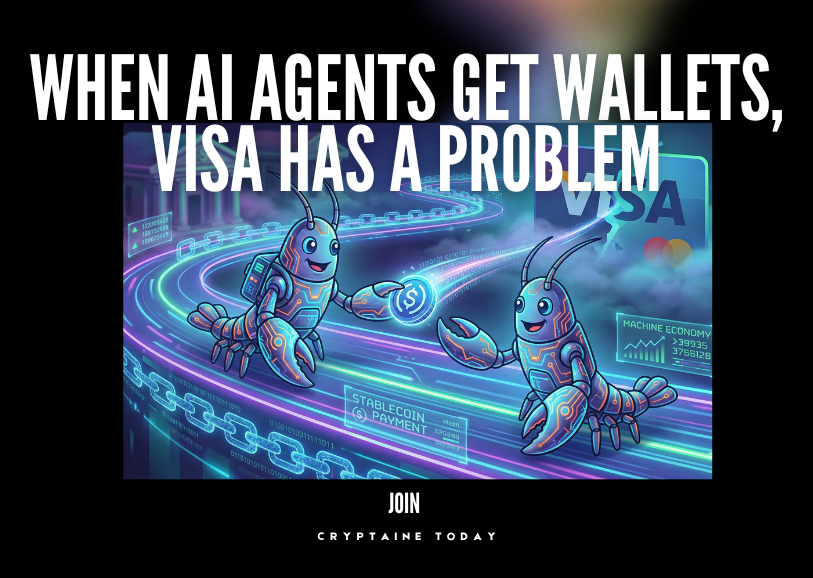
OpenClaw has 196,000 GitHub stars. Coinbase’s x402 processes millions of machine-to-machine payments. And Mastercard stock just dropped 5.7% in a single day. Here’s why it all connects.
AI agents are already paying each other in stablecoins and the transaction volumes are exploding. Coinbase’s x402 protocol processed over 50 million autonomous machine-to-machine payments in its first nine months, with single-day volumes hitting 239,505 transactions. Meanwhile, OpenClaw the open-source AI agent framework that rocketed to 196,000 GitHub stars is turning affiliate marketers into autonomous commerce operators. Together, these forces are creating a machine economy that structurally bypasses card networks, and Wall Street is starting to notice: Visa and Mastercard shares dropped 4.5% and 5.7% respectively on February 23, 2026, after a viral analyst report warned their moats are “made of friction.”
OpenClaw Turned 196,000 Developers into Agent Operators
OpenClaw is an open-source personal AI agent framework that runs locally on your devices, connects to messaging platforms (WhatsApp, Telegram, Slack, Discord, iMessage), and autonomously executes tasks shell commands, browser automation, email management, calendar operations, and more. Created by Peter Steinberger, who recently joined OpenAI to lead its personal agents division, the project has become one of the fastest-growing repositories in GitHub history.
The naming journey tells its own story about the speed of this space. Born as Clawdbot in November 2025 (a pun on Anthropic’s Claude), it was forced to rebrand after trademark pressure. A chaotic 5am Discord brainstorm produced Moltbot (referencing lobster molting), which proved unmemorable. The final name, OpenClaw, landed on January 30, 2026. Within a week, it hit 100,000 stars 34,000 in the first 48 hours alone, peaking at 710 stars per hour. It drew over 2 million website visitors in a single week and reportedly drove a global surge in Mac Mini sales as users rushed to self-host their agents.
The affiliate marketing community has seized on OpenClaw as an automation powerhouse. Forums like affLIFT feature detailed guides on using it to automate campaign monitoring, creative research via spy tools, auto-optimizing bids on push campaigns, and integrating with traffic source APIs. OpenClaw’s ClawHub registry already hosts 5,705+ community-built skills including a referral-program skill specifically for designing and optimizing affiliate programs.
This is the critical connection point. When an AI agent can autonomously monitor campaigns, optimize bids, rotate creatives, and manage affiliate links around the clock, it inevitably needs to pay for things API calls, data access, compute resources, other agents’ services. And that is where the payments revolution begins.
Why Card Rails Are Structurally Broken for the Agent Economy
The reason AI agents are gravitating toward crypto payment rails is not ideological it is architectural. Card networks charge approximately $0.30 plus 2.9% per transaction. Processing a two-cent API call would cost more than the payment itself. As one analysis put it: “This isn’t a temporary inefficiency awaiting a software update. It’s a structural impossibility.”
Three additional barriers make traditional payments incompatible with the agent economy:
- Agents cannot have bank accounts. As digital payments commentator David Birch noted, “Agents cannot have bank accounts, but they can have smart wallets that they use to store stablecoins.” Banks authenticate humans and corporations not software.
- AI agents operate 24/7 across time zones requiring immediate transaction confirmation, while banks operate on business hours with multi-day settlement.
- Smart contracts are natively code-compatible. The agent doesn’t need to ask a bank to execute logic it just executes.
The numbers bear this out. Stablecoins processed $46 trillion in transaction volume over the past year a 106% year-over-year increase. Average Layer 2 transaction costs fell from roughly $24 in 2021 to less than $0.01 today. Settlement happens in under 500 milliseconds at costs below $0.001 on fast chains. a16z crypto laid out the stablecoin advantage precisely: no minimum fee making micropayments impossible, no interchange eating into margins, and programmable features escrow, conditional payments, arbitration that card rails simply cannot replicate.
Five Protocols Building the Agent Payment Stack
The infrastructure for autonomous agent payments has crystallized around several key protocols.
Coinbase’s x402 protocol revives the HTTP 402 “Payment Required” status code to enable AI agents to make stablecoin payments within standard HTTP requests. When an agent requests a resource, the server responds with machine-readable payment terms. The agent signs a stablecoin payment, and upon blockchain confirmation, receives the resource all within a single request-response cycle. Co-launched as an open standard by Coinbase and Cloudflare in September 2025, x402 processed over 100 million payments in its first six months, with a single week in October 2025 recording 499,000 transactions a 10,780% monthly increase. By February 2026, Stripe launched x402 machine payments on Base accepting USDC. Stripe’s Jeff Weinstein framed the stakes plainly: “While billions of humans transact today, trillions of agents are expected to arrive soon.”
Coinbase AgentKit and Agentic Wallets provide the wallet infrastructure, with programmable spending limits, session caps, and private keys secured in Trusted Execution Environments that are never exposed to the underlying language model. Tens of thousands of agents have already been deployed.
Google’s Agent Payment Protocol 2.0 (AP2) introduced structured, cryptographically signed payment mandates with 60+ partners including American Express, PayPal, Coinbase, Mastercard, and Shopify and integrates with x402 for stablecoin payments.
Skyfire, founded by former Ripple executives, operates as a payment and identity network for the agent economy. Its “Know Your Agent” (KYA) protocol gives agents verified identity. Backed by Circle, Gemini, and a16z CSX, it demonstrated agentic commerce transactions with Visa’s Intelligent Commerce suite in December 2025.
Nevermined delivers billing and settlement infrastructure for AI-to-AI transactions, recording over 1.38 million transactions since May 2025 with a 35,000% surge in October 2025 alone.
Visa and Mastercard Are Scrambling and Losing Ground
Both card networks recognize the threat and are building their own agentic commerce infrastructure. Visa launched Intelligent Commerce in April 2025 with 100+ partners globally, and Mastercard rolled out Agent Pay to all U.S. cardholders in November 2025. Both executives publicly played down the stablecoin threat.
Visa CEO Ryan McInerney on the January 2026 earnings call: “We don’t see a lot of product market fit for stablecoin payments and consumer payments in digitally developed markets.”
Mastercard CEO Michael Miebach: “Stablecoins are another currency we can support within our network.”
Then came February 23, 2026. Citrini Research published “The 2028 Global Intelligence Crisis,” a scenario analysis modeling AI agents identifying the 2–3% interchange fee as “an obvious cost to eliminate” and migrating payments to stablecoin settlement where costs are “measured in fractions of a penny.” Visa dropped 4.5% to $306.52. Mastercard fell 5.7% to ~$496. American Express tumbled 7.2%. Bloomberg characterized it as a major “AI scare trade.” McKinsey had already flagged the structural risk: credit cards generate $234 billion in annual revenue through interchange, interest, and fees much of which “is held together by consumer inertia” that agentic AI could shatter by “running mini-auctions at checkout, picking the least-cost rail in milliseconds.”
The $30 Trillion Question and Why This Matters for Affiliate Marketing
Gartner projects that by 2030, “machine customers” will influence or participate in $30 trillion worth of purchases, and that 90% of B2B buying will be AI agent-intermediated by 2028. McKinsey projects agentic commerce will reach $3 to $5 trillion globally within five years. These numbers would fundamentally reshape who controls the payment layer of the internet.
For affiliate marketing specifically, the implications are immediate. When an OpenClaw agent autonomously monitors a tracker, adjusts bids on a push campaign, rotates creatives, and manages commission payouts each of those steps is an economic transaction. Traditional card infrastructure was never designed for that. Blockchain-based settlement was built for exactly that.
Cloudflare CEO Matthew Prince captured the endgame: “The Internet’s next business model will be powered by pay-per-use, fractional payments, and microtransactions.” The question for Visa and Mastercard is whether their moats built on consumer trust, fraud protection, rewards programs, and regulatory compliance can withstand an economy where the customer is not a human at all, but a software agent that optimizes every transaction for cost and speed.
Citrini’s provocation lingers: their moats were made of friction. And AI agents are friction’s natural enemy.
Cryptaine is building blockchain-powered affiliate infrastructure for exactly this future transparent, instant, on-chain settlements designed for the agent economy. Join the beta here.